VISUAL LITERACY/PICTUREBOOKS
THE MONSTER IN THE LAKE
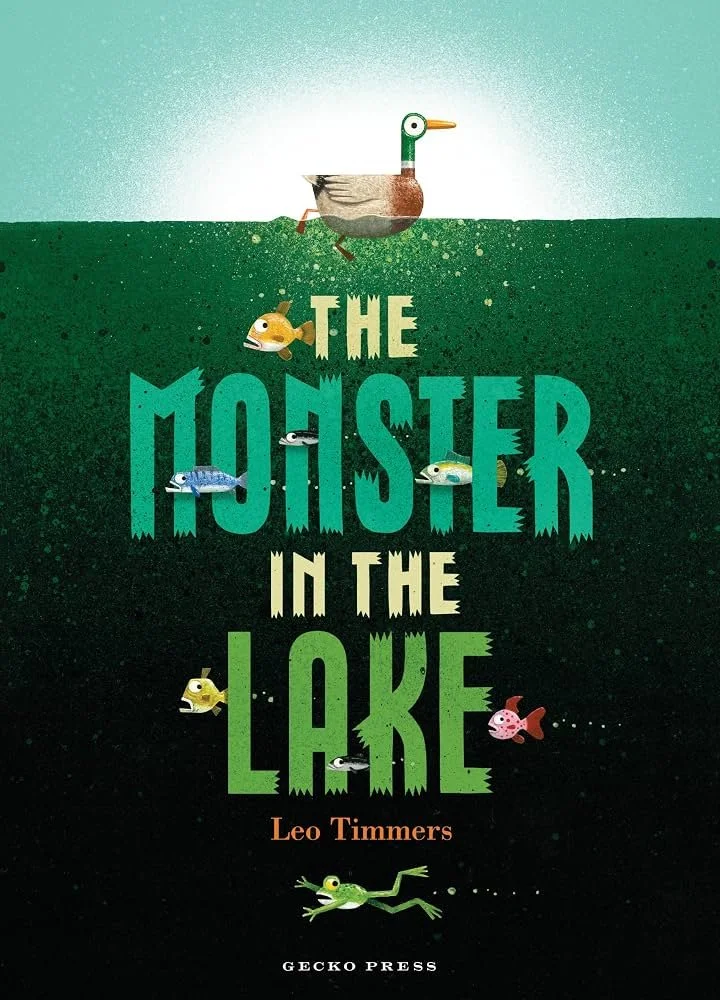
Leo Timmers
The Monster in the Lake looks like a book for the youngest children. But simple doesn’t mean simplistic. Leo Timmers gives his readers something the ducks don’t have: a different view of what is happening. Children get to notice, question and disagree. They aren’t just listening to a story. They are working it out.
GECKO PRESS · 2025 · AGES 4-7
01
LOOKING OUT FOR CLUES
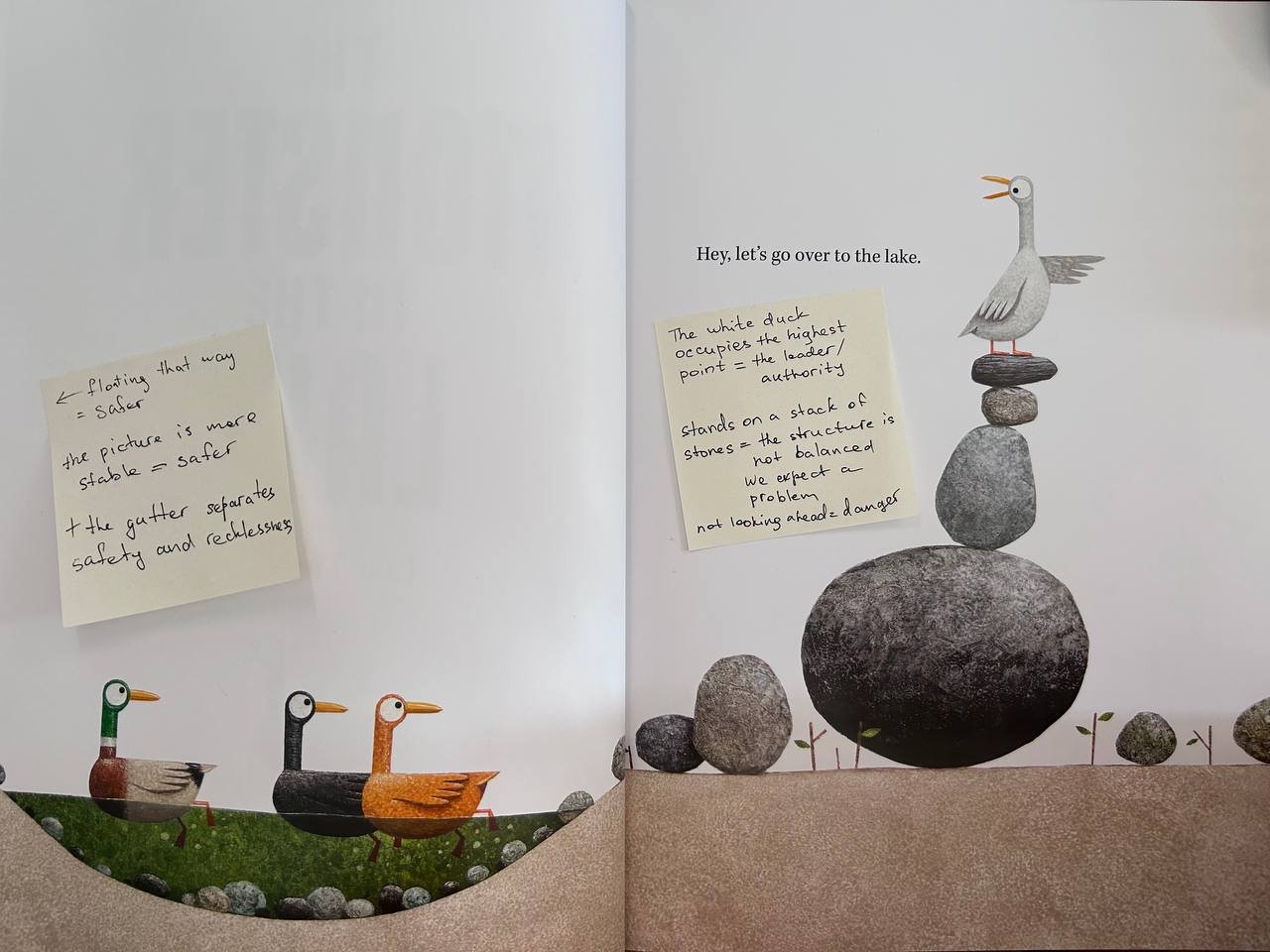
The words give us an invitation, while the picture gives us reasons to question it.
Even when working with four-year-olds, I teach them to look not only at what’s happening in the book, but also at how it is pictured.
The white duck occupies the highest point, which can suggest authority. But he stands on a narrow pile of rounded stones and the suggested adventure now seems too dangerous.
Would you follow the duck? What in the picture makes you trust or doubt it?
02
THE WORRIED DUCK
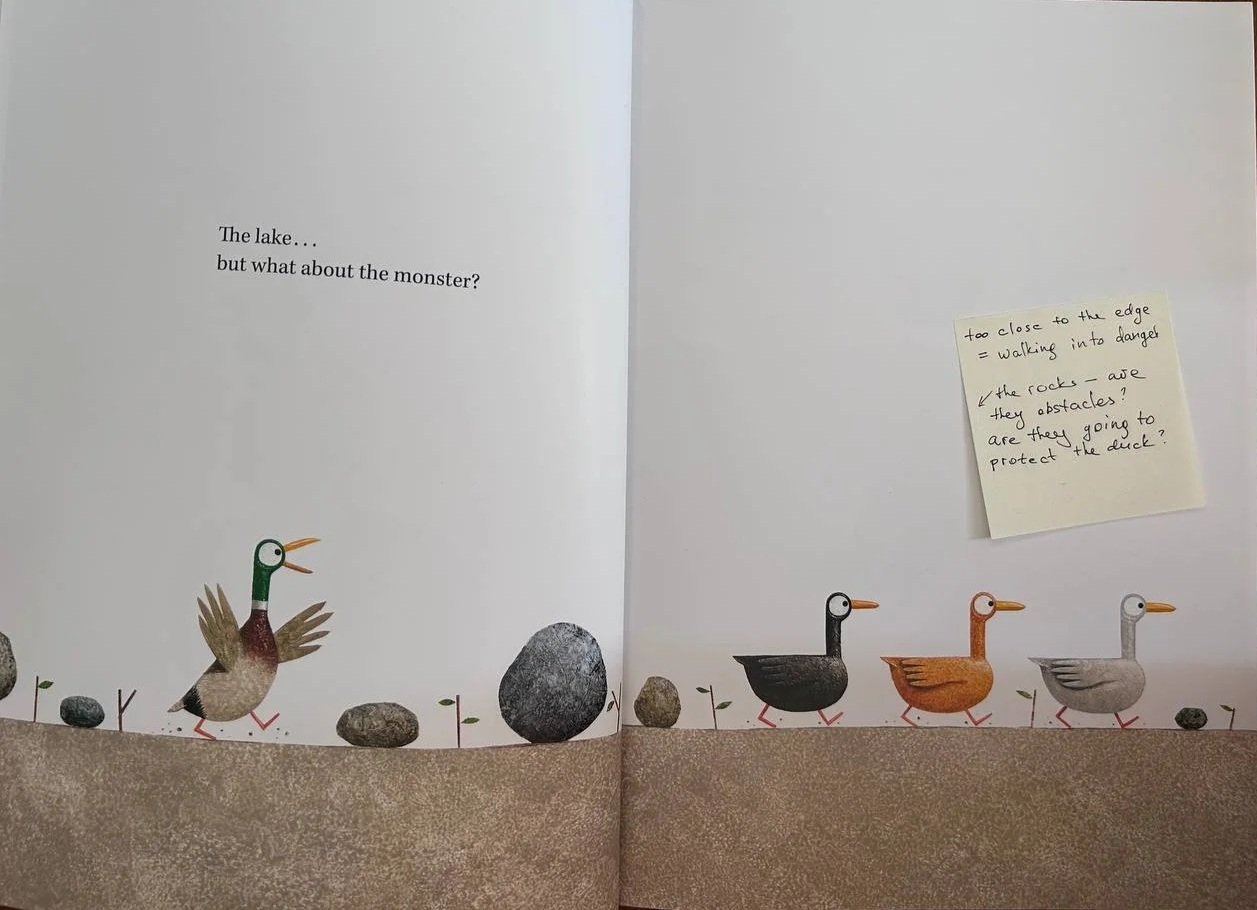
Learning about character positioning helps children to decode the author’s intent. They can learn to tell which duck is worried not only by judging its expression, but also by noticing its position way behind the others.
Are the ducks aware of what’s in front of them?
03
VIEWPOINT
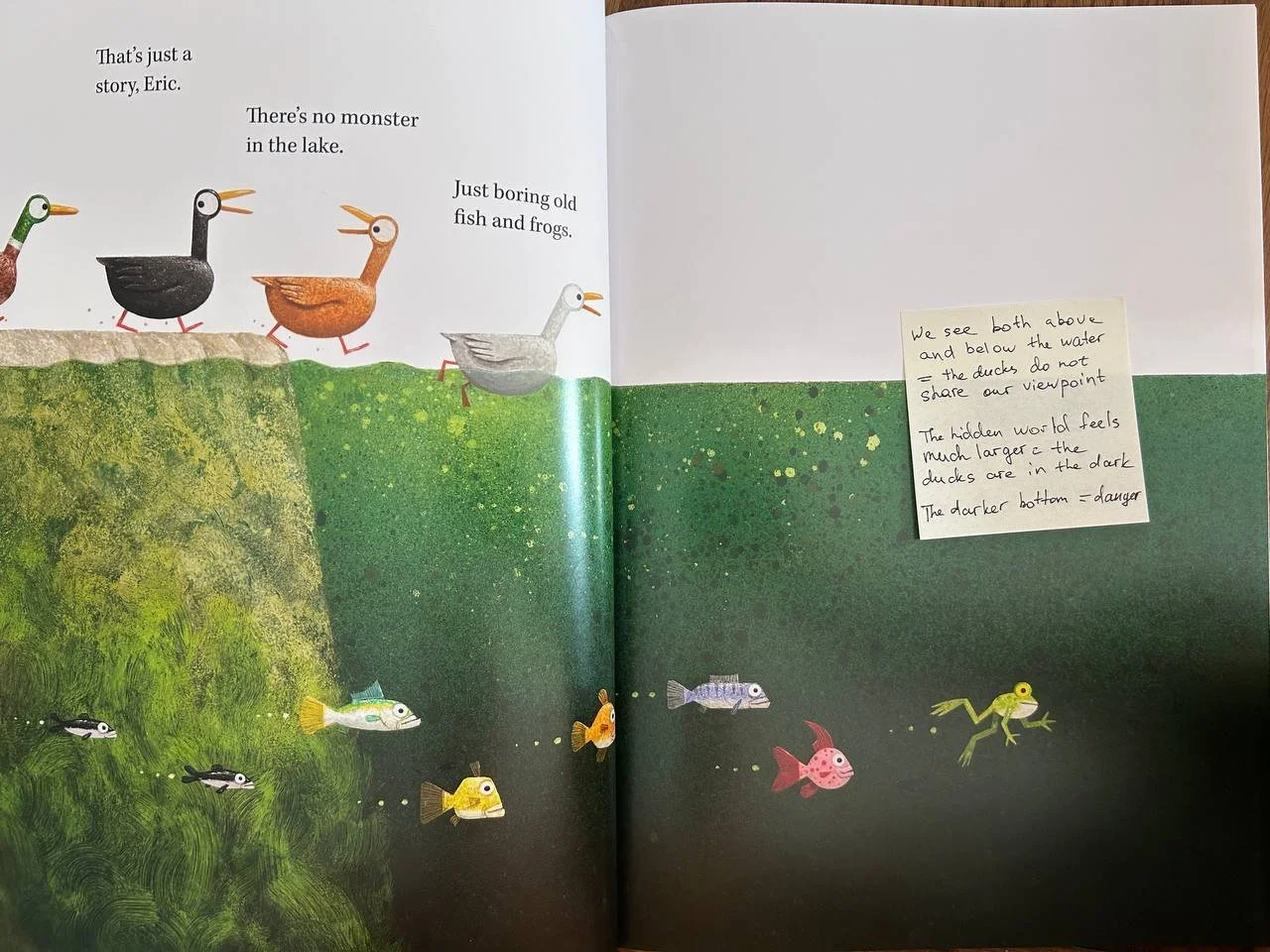
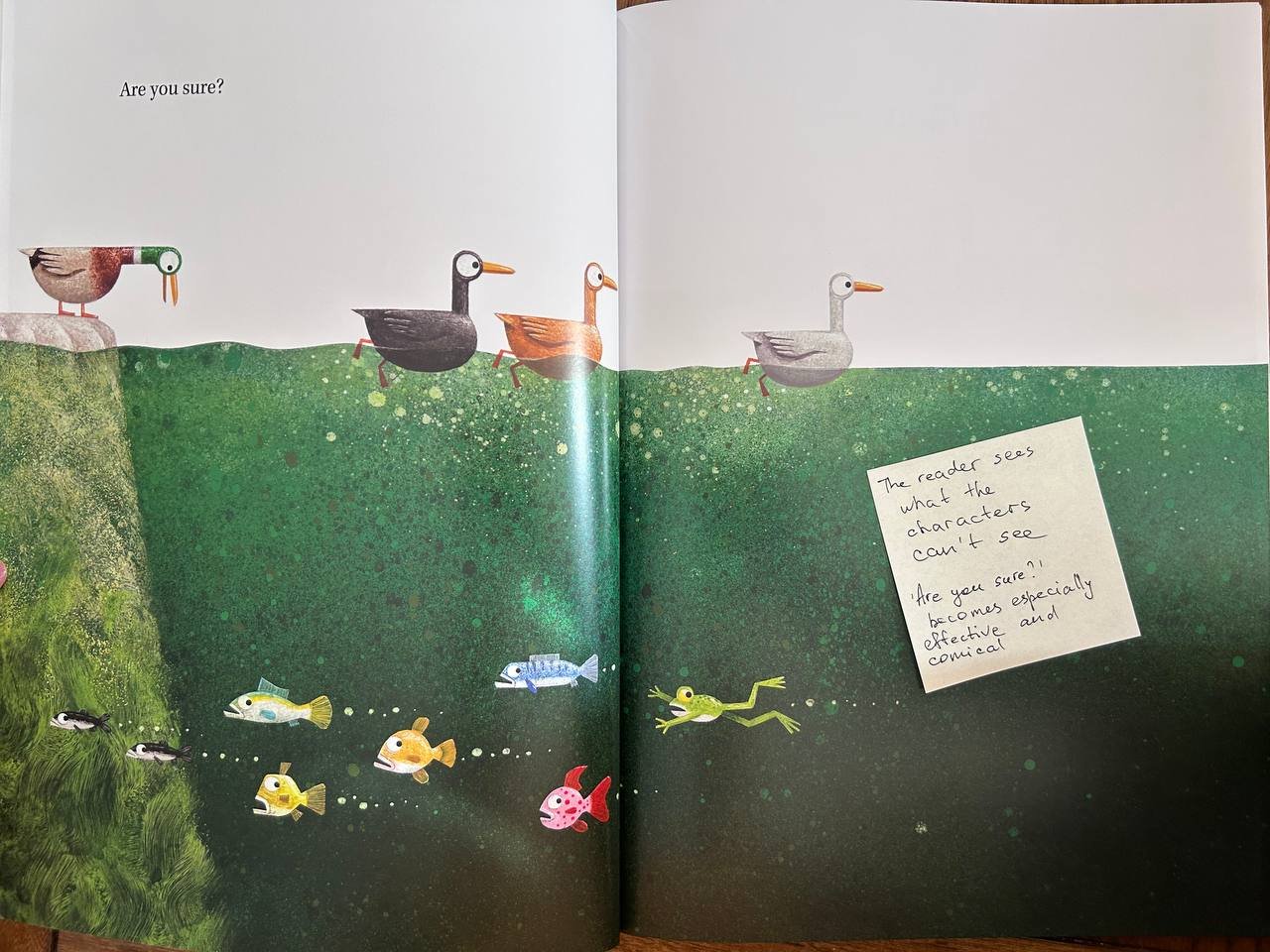
Now our viewpoint changes: we can see both above and below the water. The ducks make confident claims about a world we can inspect from a different angle.
The underwater space dominates the spread, making the ducks look small beside everything beneath them. The water darkens towards the bottom, suggesting depth and making it harder to see what might be there.
There’s also humour in “boring old fish and frogs”: the fish are colourful, patterned and individually different. Children can question that description just by looking.
The ducks are saying there’s no monster. Does the picture prove they are right?
04
ARE YOU SURE?
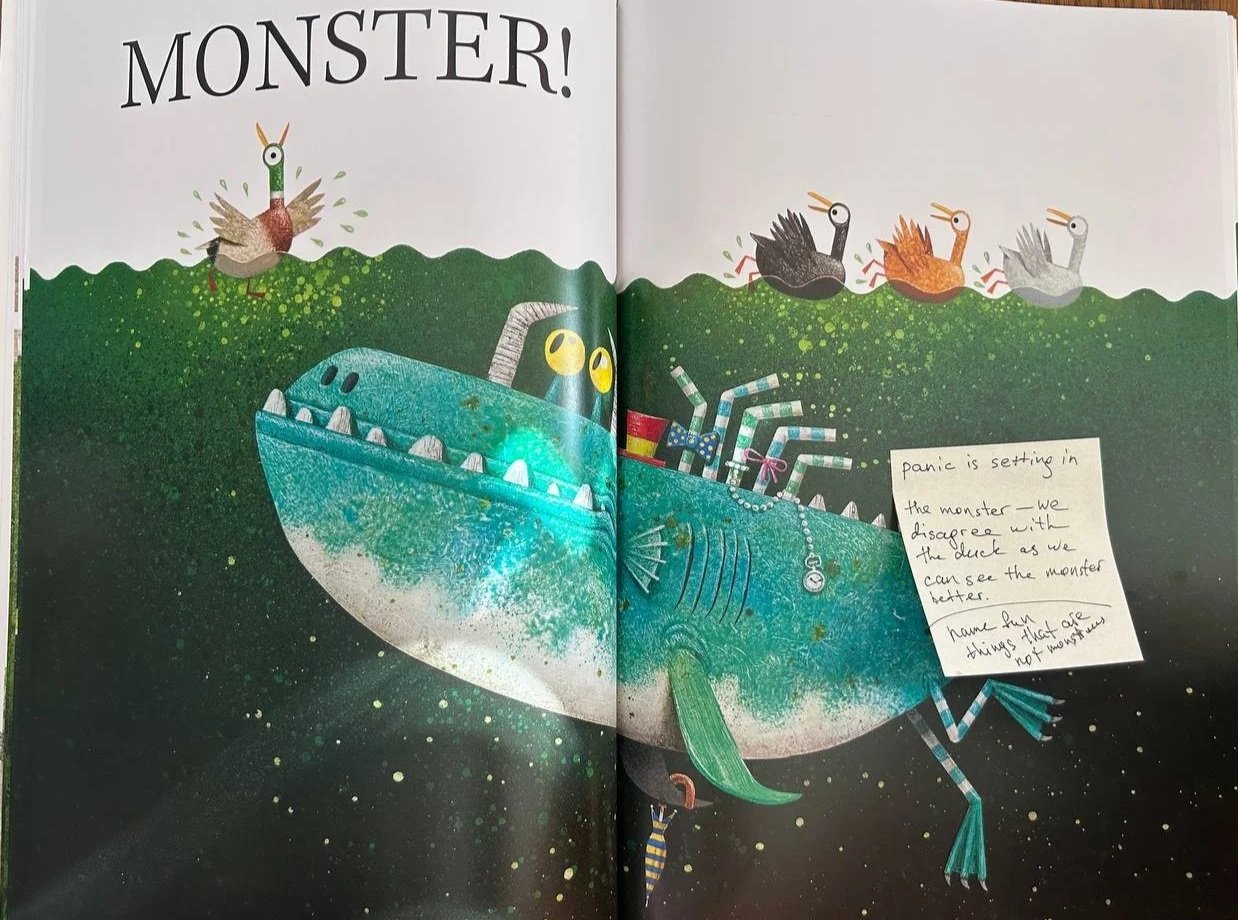
Eric is talking to the ducks, but it is the reader who answers. The question reads like an invitation to look closer and decide for ourselves. The ducks seem sure, but the fish are already swimming in the opposite direction. What have they noticed that the ducks haven’t? What do the fish know that we don’t? Leo Timmers has added another viewpoint, and now we are just like those ducks.
05
IT IS NOT
Leo Timmers’s illustrations contradict the text throughout the book. This is one of the reasons I bought it. It really helps to encourage even the quietest of the kids to talk. The monster is not scary at all! Can’t you see?
READ MORE
A CLOSER LOOK AT THE MONSTER IN THE LAKE
There is a fold-out spread in the book that reveals a colourful panoramic illustration. The hidden world is literally hidden, and we can explore it if we are curious enough. Colourful fish and monsters, together with their new friend Eric, have fun that the three ducks will never have because they refuse to look, pay attention and be curious about the lake.
The book is more than an adventure with clever illustrations. It also encourages us to look closely at nature, stay curious and care about the worlds we might otherwise overlook. The bottom of the lake is full of rubbish. It is a dump. The fish are trying to organise it all and use it as building material. It does look fun and colourful. My students recognised a few things that we might see in a city and suggested how they might have ended up in the water.
You can’t help but notice how much stuff is in the water. Leo isn’t trying to make us feel sad, though. The fish don’t seem unhappy or worried. But he doesn’t try to hide the rubbish either. It is there for us to see, and the fact that it is all colourful doesn’t change the fact that it is rubbish.
What if the monster is there because of us? What if we are the ducks who refuse to see? Could this be a metaphor Leo Timmers wants us to think about?
LEARNING WITH GREGORY HALL SCHOOL
WE DON’T JUST READ BOOKS.
WE LEARN HOW TO LOOK.
Our literature classes teach children to notice what others might miss - to question pictures, follow visual clues, make connections and discover how stories work.